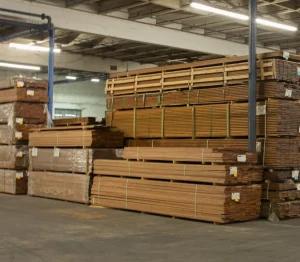


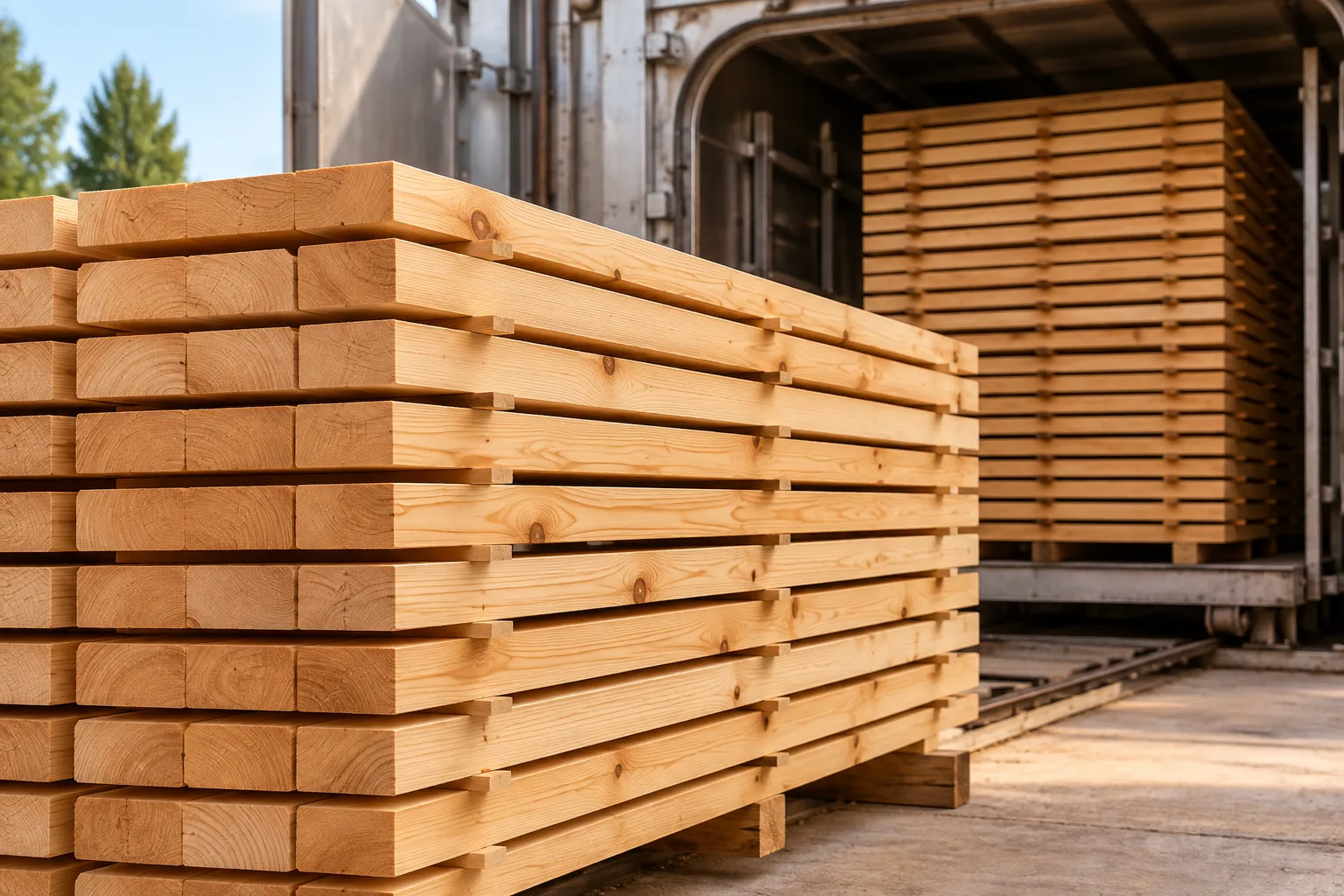
Kiln-dried lumber is wood that has been carefully dried inside a controlled chamber called a kiln. The drying process removes excess moisture from freshly cut or green lumber, helping the wood become more stable and ready for construction, furniture, flooring, and other projects.
Freshly cut wood naturally contains a significant amount of moisture. If that moisture is not properly reduced before the lumber is used, the wood can shrink, warp, crack, or change shape as it dries naturally.
Kiln drying provides a controlled way to reduce the moisture content of lumber before it reaches the job site or manufacturing facility. This makes kiln-dried lumber a popular choice for projects where dimensional stability and predictable performance are important.
Kiln drying takes place inside a specially designed chamber where temperature, humidity, and airflow can be controlled.
Fresh lumber is placed inside the kiln and exposed to carefully managed conditions. Warm air circulates around the boards and gradually removes moisture from the wood.
The process does not simply involve heating the wood as quickly as possible. Drying too quickly can cause problems such as checking, cracking, and other defects. Instead, the drying schedule is adjusted according to the wood species, thickness, moisture level, and intended use.
As the process continues, moisture moves from inside the wood toward the surface and then into the surrounding air.
Once the lumber reaches the desired moisture content, it can be removed from the kiln and prepared for further processing or use.
The main reason lumber is kiln dried is to reduce its moisture content in a controlled way.
Wood naturally loses moisture after a tree is cut. As this happens, the dimensions of the wood can change.
For example, lumber may become narrower or thinner as it dries. It can also develop warping, twisting, bowing, or cracking.
Kiln drying allows much of this moisture reduction to happen before the lumber is used in a finished project.
This can make the wood more predictable and stable compared with freshly cut green lumber.
There is no single moisture content that applies to every piece of kiln-dried lumber.
The target moisture content depends on the species, thickness, intended application, and drying schedule.
For many interior applications, lumber is dried to a relatively low moisture content because indoor environments are generally drier than outdoor environments.
Outdoor lumber may have a different target because it will be exposed to changing humidity and weather conditions.
The important point is that kiln drying is intended to bring the lumber to a moisture level appropriate for its intended use.
Both kiln drying and air drying remove moisture from wood, but they use different methods.
Air-dried lumber is stacked in an open or covered area and allowed to dry naturally. Air movement and environmental conditions gradually remove moisture from the boards.
Kiln-dried lumber is placed inside a controlled chamber where temperature, airflow, and humidity can be managed.
Air drying can take considerably longer because the process depends heavily on weather and environmental conditions.
Kiln drying provides greater control over the drying process and can reduce the moisture content to levels that may be difficult to achieve through outdoor air drying alone.
However, the best drying method depends on the wood species, intended application, production requirements, and desired characteristics.
One of the main benefits of kiln-dried lumber is improved dimensional stability.
When wood has already been dried to an appropriate moisture content, there is generally less moisture-related movement after installation.
This can help reduce problems associated with excessive shrinking and movement.
Properly dried lumber is less likely to experience significant changes caused by moisture loss after installation.
This does not mean kiln-dried lumber will never warp. Wood is a natural material and can still respond to changes in humidity and environmental conditions.
However, controlled drying can help make the material more predictable.

Kiln-dried lumber is commonly used for interior construction, furniture, cabinetry, flooring, trim, and other applications where moisture content is important.
Wood used indoors needs to be compatible with the relatively stable moisture conditions of an interior environment.
Dry lumber can be easier to cut, machine, sand, and finish compared with freshly cut wood.
Lower moisture content can also make the lumber more suitable for manufacturing processes where predictable dimensions are important.
Paints, stains, coatings, and other finishes generally perform better when applied to properly prepared wood.
Using lumber with an appropriate moisture content can help reduce problems caused by continued moisture loss after finishing.
Kiln drying does not simply make every piece of lumber stronger.
The strength of wood depends on many factors, including species, grain orientation, density, defects, moisture content, and how the wood is processed.
Reducing moisture can improve certain mechanical properties compared with green wood, but the main purpose of kiln drying is moisture control and improved stability rather than simply increasing strength.
It is important to choose lumber based on the requirements of the specific project rather than assuming that kiln-dried automatically means stronger.
Yes, kiln-dried lumber can still shrink.
The difference is that much of the moisture reduction has already occurred before the lumber is used.
Wood can continue to gain or lose moisture as environmental conditions change. When the moisture content changes, the wood can expand or contract.
Properly dried lumber is therefore not completely immune to movement. Instead, it starts closer to the moisture condition appropriate for its intended environment.
Yes. Kiln-dried lumber can absorb moisture if it is exposed to rain, high humidity, wet ground, or other sources of water.
Getting wet does not necessarily mean the lumber is permanently damaged. However, the wood may need to dry again before it is installed or enclosed.
For example, if kiln-dried boards are delivered to a construction site during heavy rain, they should be protected from unnecessary moisture exposure.
Proper storage is important.
Kiln-dried lumber should be stored in a clean, dry, and well-ventilated location.
Keep the boards elevated from the ground and protect them from direct exposure to rain and standing water.
When possible, stack lumber flat and provide enough airflow around the boards.
Avoid storing dry lumber in conditions that are significantly different from the environment where it will eventually be installed.
Good storage practices help the lumber maintain an appropriate moisture level and reduce unnecessary movement.
Kiln-dried lumber can be used for outdoor projects, but the type of wood and its treatment are important.
Not every kiln-dried board is automatically suitable for outdoor exposure.
For exterior applications such as decks, fences, siding, and outdoor structures, the wood should be selected based on its natural durability, moisture resistance, treatment, and expected exposure.
Some species perform better outdoors than others.
For example, naturally durable hardwoods can be used for certain exterior applications because of their resistance to moisture and decay.
Kiln drying is one part of the lumber preparation process. It does not automatically make a wood species weatherproof or rot resistant.
Yes. Many hardwood species are kiln dried.
Hardwoods such as oak, maple, walnut, cherry, ash, and various tropical hardwood species can be kiln dried for different applications.
The drying process for hardwoods can require careful control because different species have different drying characteristics.
Some hardwoods are more susceptible to checking, cracking, or other drying defects if the process is too aggressive.
Experienced mills use species-specific drying schedules to help manage these risks.
Yes. Softwoods are also commonly kiln dried.
Species such as pine, spruce, fir, cedar, and other softwoods can be kiln dried for construction and manufacturing applications.
The appropriate drying schedule depends on the species and the intended use of the lumber.

Kiln-dried lumber is widely used in construction because predictable moisture content can be important for framing and other building applications.
When lumber is installed at an appropriate moisture level, there may be less movement as it adjusts to its surrounding environment.
This can help improve the consistency of construction.
However, builders should still follow applicable building codes and specifications and select lumber according to the structural requirements of the project.
Furniture makers often value kiln-dried lumber because stability is important when making tables, cabinets, chairs, doors, and other products.
A piece of furniture may contain several individual boards joined together. Significant movement after construction can place stress on joints and affect the finished appearance.
Using properly dried lumber helps reduce some of these moisture-related issues.
The wood species still matters, and furniture makers need to consider grain direction, board orientation, humidity, and construction methods.
The easiest way to determine whether lumber is kiln dried is to check the product information or ask the lumber supplier.
A supplier should be able to provide information about the wood species, moisture content, drying process, grade, dimensions, and intended application.
Visual appearance alone is not always enough to determine whether a piece of lumber has been kiln dried.
A moisture meter can also be used to measure the moisture content of wood, although moisture content by itself does not always prove how the lumber was dried.
For many projects, kiln-dried lumber can be a practical choice because the drying process provides better control over moisture content and can improve dimensional stability.
It can be particularly useful when the wood will be used for furniture, flooring, interior construction, cabinetry, or other applications where excessive movement could create problems.
The value depends on the project. The cost of kiln-dried lumber may be higher than some green or air-dried alternatives, but the additional processing can provide benefits in terms of stability, workability, and preparation.
The drying time depends on the wood species, board thickness, starting moisture content, kiln temperature, and drying schedule. Some lumber can take several days, while thicker or more difficult-to-dry species may require longer.
It can often be used after reaching the appropriate moisture content, but it may need time to acclimate to the environment where it will be installed. This is especially important for flooring, furniture, and interior woodworking.
Yes, acclimation can be useful before installation because the lumber may need to adjust to the temperature and humidity of its final environment.
Kiln drying can help reduce moisture-related problems, but it does not guarantee that lumber will never crack. Wood can still develop cracks or checks due to changes in moisture, handling, installation, or environmental conditions.
Yes. Kiln-dried lumber can generally be stained once the wood has reached an appropriate moisture content and the surface has been properly prepared.
Yes. Properly dried lumber can be painted after the surface is clean, dry, and prepared according to the requirements of the chosen paint.
Generally, yes. Removing moisture reduces the weight of the wood, although the difference varies depending on the species and original moisture content.
Kiln drying may help reduce or eliminate some insects present in freshly harvested wood, but it should not be considered a permanent insect-proofing treatment.
Yes, kiln-dried lumber is commonly used for structural applications when it meets the required species, grade, dimensions, and applicable building standards.
A wood moisture meter can provide a moisture-content reading. For project-specific requirements, it is also useful to obtain moisture and product information directly from the lumber supplier.
Kiln-dried lumber is wood that has been dried inside a controlled kiln to reduce its moisture content before use. The process helps make lumber more stable and predictable and can reduce some of the movement associated with naturally drying wood.
It is used across many applications, including construction, furniture, flooring, cabinetry, and selected outdoor projects.
When choosing kiln-dried lumber, consider more than just the fact that it has been kiln dried. Look at the wood species, moisture content, grade, dimensions, intended application, durability, and storage conditions.
Choosing the right lumber for the environment and project requirements will help you get better long-term performance from the wood.